


.. Photo by Elvira Bojadzic. © Islamic Arts Magazine
Art Dubai closed 2022 edition with strong sales and record visitor numbers



.. Photo by Elvira Bojadzic. © Islamic Arts Magazine
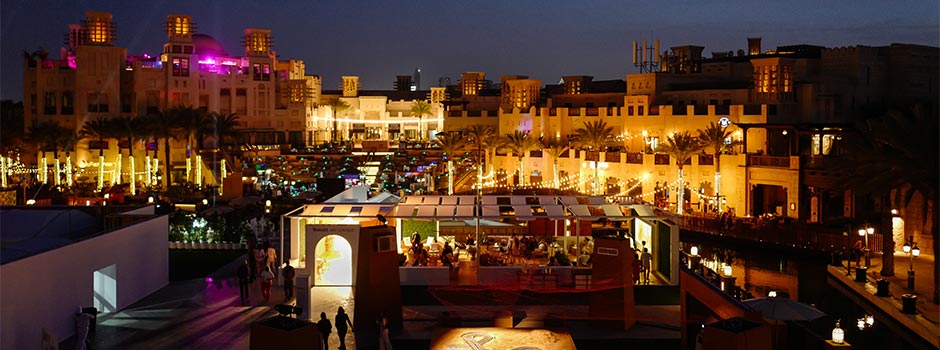
Art Dubai closed its 15th edition on Sunday 13 March 2022, with strong sales reported across all four sections of the fair: Modern, Contemporary, Bawwaba and Art Dubai Digital. Marking a full-scale return at Madinat Jumeirah, Art Dubai’s 2022 edition was the fair’s largest to date, with a record attendance of more than 30,000 visitors across five days. The fair’s success reinforces the growing importance of Dubai as an international hub for art and culture and innovation and technology and Art Dubai as the marketplace for art and artists from the Global South.

ANNA LAUDEL, Art Dubai 2022. Installation view / Photo by Cedric Ribeiro, Getty Images for Art Dubai

Art Dubai 2022. General Fair Imagery / Photo by Cedric Ribeiro, Getty Images for Art Dubai

Art Dubai 2022. General Fair Imagery / Photo by Cedric Ribeiro, Getty Images for Art Dubai

Art Dubai 2022. General Fair Imagery / Photo by Cedric Ribeiro, Getty Images for Art Dubai
Art Dubai 2022 featured more than 120 presentations by 104 galleries and platforms from 44 countries. Newly commissioned works complemented the gallery programme from leading international artists and an oversubscribed, innovative talks programme, bringing together some of the world’s brightest minds through the 15th edition of Global Art Forum and the new Bybit Talks Series. Art Dubai 2022 also featured the debut edition of Art Dubai Digital, a new physical gallery section presenting a curated selection of 17 of the most cutting-edge digital platforms internationally. This was their first experience exhibiting in a traditional fair context for many platforms with in-person and online sales.

Art Dubai 2022. Art Dubai Digital, Installation view / Photo by Cedric Ribeiro, Getty Images for Art Dubai

Art Dubai 2022. Art Dubai Digital, Installation view / Photo by Cedric Ribeiro, Getty Images for Art Dubai

Art Dubai 2022. Art Dubai Digital, Installation view / Photo by Cedric Ribeiro, Getty Images for Art Dubai

Art Dubai 2022. Art Dubai Digital, Installation view / Photo by Cedric Ribeiro, Getty Images for Art Dubai
Art Dubai’s Artistic Director Pablo del Val commented: “This was, without doubt, one of the most successful editions of Art Dubai, in terms of both visitors and sales reported, fully reflecting Dubai’s position as an engine of global growth and a city no longer of the future, but of the here and now. The response from audiences and collectors to the debut edition of Art Dubai Digital has been truly incredible. Art Dubai prides itself on being a fair of innovation and forward-thinking, and there was a real freshness and energy to the 2022 edition across the whole programme.”
Kristin Hjellegjerde, Founder, Kristin Hjellegjerde Gallery: “We had a very successful week, there was a lot of positive energy, and we sold multiple works to both new and returning clients. Dubai is a city in transition, and there is undoubtedly a growing collector scene here, at all levels.”

Art Dubai 2022. General Fair Imagery / Photo by Cedric Ribeiro, Getty Images for Art Dubai

Art Dubai 2022. General Fair Imagery / Photo by Cedric Ribeiro, Getty Images for Art Dubai

Art Dubai 2022. General Fair Imagery / Photo by Cedric Ribeiro, Getty Images for Art Dubai

Art Dubai 2022. Installation view / Photo by Cedric Ribeiro, Getty Images for Art Dubai
Victoria Cooke, Director, Gallery 1957: “This is our third time at Art Dubai and our most successful edition yet – it’s great to be back. On the opening day we sold works to African-American, South Asian, and regional collectors. Dubai is a truly international place, and it’s been an incredibly positive experience.”
Priyanka Raja, Founder, Experimenter: “We had a very successful week, selling almost all the works we brought, mostly to institutions. It’s been one of the strongest editions in Art Dubai’s history, in terms of the quality of the galleries and the art they are showing, and in the conversations we have had. We have met people here from all over the world, made sales to new people and it has been an incredibly fruitful week for us. There has been a constant buzz, on all days of the fair, and as well as the sales we make, Art Dubai is a facilitator or longer-term conversations and feels like a moment of celebration for our artists.”
Asmaa Al-Shabibi, Founder, Lawrie Shabibi Gallery: “We had a good fair this year, with strong sales across our booth and gallery – overall the energy, interest and excitement was back to levels not seen for many years even before the pandemic.”
Joe Kennedy, Founder, Institut.co: “We were thrilled to be invited to participate in Art Dubai’s inaugural Digital section which brought together an impeccably curated cross-section of platforms, galleries and DAOs from this innovative and rapidly expanding space. It was a great opportunity for Institut to meet members of our community IRL and educate and engage with a truly global audience, and we had a very successful week.”

Art Dubai 2022. Installation view / Photo by Cedric Ribeiro, Getty Images for Art Dubai

Art Dubai 2022. Installation view / Photo by Cedric Ribeiro, Getty Images for Art Dubai

Art Dubai 2022. Installation view / Photo by Cedric Ribeiro, Getty Images for Art Dubai

Art Dubai 2022. Installation view / Photo by Cedric Ribeiro, Getty Images for Art Dubai
Henry Brand, Fingerprints DAO: “We chose to do a hybrid booth including both online and IRL elements and we sold very well, with lots of NFTs being minted in person here at the booth – by collectors of all ages, and a really wide demographic. It’s our first time participating in an art fair and we chose a particularly challenging presentation that expands the use of the blockchain as a medium for artists.”
Dima Abdul Kader, Emergeast: “Art Dubai has been absolutely fantastic for us – the feedback and the traffic has been hugely positive and inspiring. Sales have been great and we almost sold out the booth. This feels like a unique moment in time, and in 12 months it will be a different landscape.”
Thomas Brambilla, Founder, Thomas Brambilla: “It was our first time here at Art Dubai and we sold extremely well. It was a beautiful week and we really enjoyed it, in what is a completely new part of the world for us, and one where we plan to do more. Dubai is becoming ever more important, it’s a gateway to the region, and we met a lot of new, serious collectors this week.”
Matteo Consonni, Founder, Madragoa: “This is our first experience of Art Dubai and it has been an extremely positive one. We are a young European gallery and this week we feel like we have been in the centre of the melting pot that is Dubai. Sales were consistent across the week and we were pleased to sell out the booth.”

Art Dubai 2022. General Fair Imagery / Photo by Cedric Ribeiro, Getty Images for Art Dubai

Art Dubai 2022. General Fair Imagery / Photo by Cedric Ribeiro, Getty Images for Art Dubai
Founded in 2007, Art Dubai is the premier platform to see and buy modern and contemporary art from the Global South. Featuring Contemporary, Modern and Digital gallery sections, annual artist commissions and year-round collector and education programmes, Art Dubai champions art and artists from across the Global South, providing a relevant and increasingly important alternative to mainstream, largely Western-led narratives.
Art Dubai is held under the patronage of HH Sheikh Mohammed bin Rashid Al Maktoum, Vice President and Prime Minister of the UAE and Ruler of Dubai. Art Dubai is held in partnership with ARM Holding. The lead partner of the fair is Swiss Wealth Management Group Julius Baer. The Dubai Culture & Arts Authority (Dubai Culture) is the fair’s strategic partner. Bybit is the lead partner of Art Dubai Digital.
.. Photo by Elvira Bojadzic. © Islamic Arts Magazine
Rina Banerjee challenges current nativist political leanings by proposing a multi-faceted nature of identity; not based exclusively on a person’s culture of origin or gender, but instead on self-identity. These inclusive and freeing conceptions of the “self†manifest themselves throughout Banerjee’s ever-evolving work, in fragmented figures, riotous use of colour, and symbolic materials. Paired with her thought-provoking and poetic titles, Banerjee in her work relentlessly query contemporary modes of artistic production and societal engagement.
Salima Hashmi says about her practice, “As we seek to document our turbulent times, the fragile and the vulnerable weigh upon the inner eye. Remembered images of night and day spread out; carpets and tapestries, mapping our journeys.â€
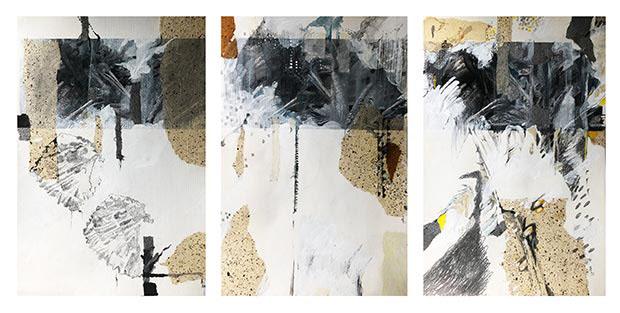
An artist with an international sensibility, Chittrovanu Mazumdar draws from an ever-shifting sea of various sources. Dramatic plays of light and colour values are visual hallmarks of his sophisticated oeuvre. Mazumdar’s imagery emerges out of daily discoveries: a word, a glance, the heartrending/blood-chilling phrase, a fleeting mise en scène – the rise and crest of body parts imprisoned in tight freeze-frame: both source and association are intensely private and sensual. In his paintings, we see contours of anatomy slipping into/emerging from non-representative fields of colour.
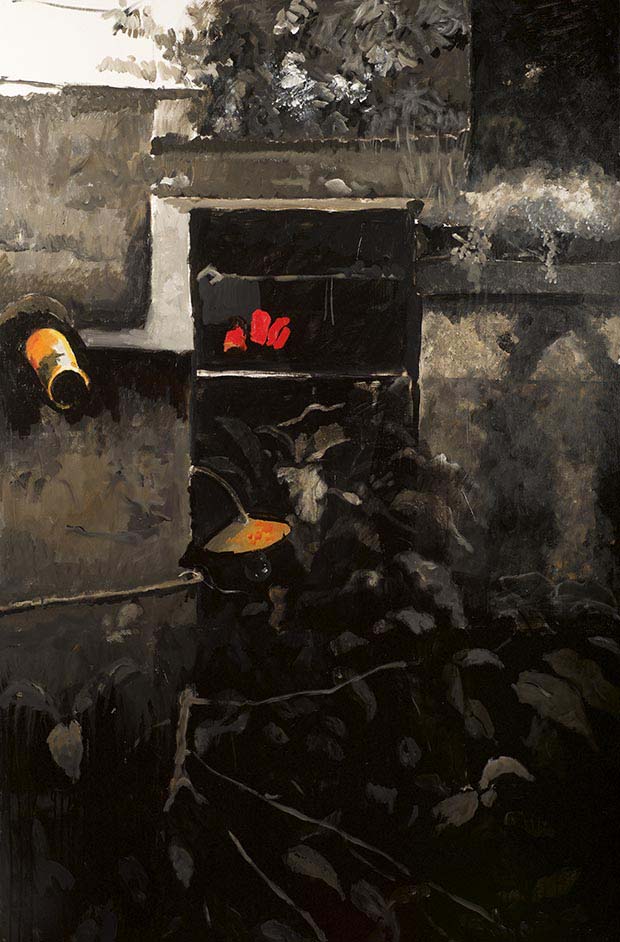
Wardha Shabbir is rendering countless dots that come together as units to form an idea(s) on the surface. The “Nuqta/Dot†is symbolizing infinity and life. Akin to miniature paintings for manuscript illustration, she has delicately picked organic symbols of earth, water and sky to paint contemporary utopian pathways or Siraat, signifying a course of clarity between a clutter of contradictory values and states of being.
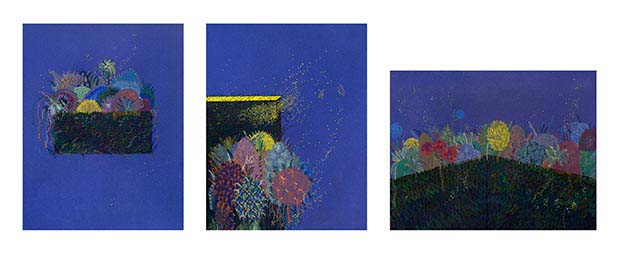
Madhusudhanan shows in his works his enduring fascination with early Indian cinema as a historical medium, replicating film stills and figures from the silent era. Madhusudhanan insists on making a series of images rather than the singular in imitation of the cinematic language. This painting, which comes from memories of the myth of the historical flood closely parallels the story of creation: a cycle of creation, un-creation, and re-creation, in which the Ark plays a pivotal role. The triptych fuses the narrative of the biblical flood in connection to migrants in search of a home.
Ghulam Mohammed’s practice places itself at the intersection of the range and limitations of language, both as a visual, formal construct as well as a conveyor of meaning. The tension between the capacities of language, to both impart form, as well as interpretation. It is this interplay between appearance and potential, orientation and performance, the primary motive force behind the process of the practice as well as the work it produces.
.. Photo by Elvira Bojadzic. © Islamic Arts Magazine
Laleh Khorramian (b. 1974 Tehran, Iran) presents a hall of small paintings: oil on panel and linen works flanking one side of the booth and stretched mixed media fabric works on the other. Holding court at the centre is Mother of Glass (2021), which was first exhibited at the Baltic Centre for Contemporary Art as part of The Vasseur Baltic Artists’ Award 2022.
The suite of small paintings exists in a state of rotation around the command of her femininity. Each piece is layered with the mercurial methodologies of Khorramian’s practice – from oil to fabric, carving to stitching. Paramount is the artist’s hand; her paintings are rendered with exquisite detail and depth, and her sewn compositions are collages of painted fabrics with stencilled patterns and found textures. All of the works touch on both abstraction and surrealism, the effect of which is both haunting and transportative.
Laleh Khorramian (b. 1974 Tehran, Iran) studied at the Rhode Island School of Design (Providence, RI), received her undergraduate degree at The School of The Art Institute of Chicago (Chicago, IL), and her MFA at Columbia University (New York, NY). Khorramian has exhibited internationally in both solo and group exhibitions, including but not limited to Perpetual Inventory, Volume 1: An Exercise in Looking curated by Dr Omar Kholeif, The Third Line, Dubai, UAE (2022); The Vasseur Baltic Artists’ Award 2022, Baltic Centre for Contemporary Art, Gateshead, UK; The Refracted Body, Liverpool Biennale, Liverpool, UK (2021); Earthly, Esther Massry Gallery, The College of Saint Rose, Albany, NY, USA (2021); Sentients, Fine Art Center Gallery, University of Arkansas, Arkansas, USA (2020); Drawn: Concept and Craft, Southeastern Center for Contemporary Art, Winston Salem, NC, USA (2020); Unearth, September Gallery, Hudson, New York, USA (2019); Saturns Neckless, The Third Line, Dubai, UAE (2016); Midnight Moment: Laleh Khorramian, Times Square, New York, USA (2014); to name a few.

Laleh Khorramian, Relics from dream. 2023. 35.56 x 27.94 x 3.56 cm / Courtesy of the artist and The Third Line, Dubai

Laleh Khorramian, Mother of its, 2023, Acrylic, cotton, velvet on canvas, 35.56 x 27.94 x 3.81 cm / Courtesy of the artist and The Third Line, Dubai

Laleh Khorramian, Red no one, 2023, Acrylic, velvet on canvas, 35.56 x 27.94 x 3.81 cm / Courtesy of the artist and The Third Line, Dubai

Laleh Khorramian, Calling, 2023, Acrylic, velvet on canvas, 27.94 x 35.56 x 3.81 cm / Courtesy of the artist and The Third Line, Dubai

Laleh Khorramian, Red swell, 2023, Oil on panel, 35.56 x 27.94 x 3.56 cm / Courtesy of the artist and The Third Line, Dubai
For over half a century, the practice of the late Monir Shahroudy Farmanfarmaian (b. 1922 Qazvin, Iran, d. 2019 Tehran, Iran) has incorporated principles of Islamic geometry with a contemporary sensibility. Blending the characteristics of ornamentation found in Iranian architecture with the aesthetics of modern and abstract expressionism, Farmanfarmaian’s unconventional melange of past and present has resulted in an oeuvre that spans many mediums. The presentation reflects upon these different facets and materials of her geometric practice. It features a range of drawings, carpets, and iconic mirror works to demonstrate the depth of Farmanfarmaian’s conceptual consideration throughout her career and medium.
Farmanfarmaian is best known for her mirror mosaic sculptural works, whereby fragments of reverse-painted, reflective glass are arranged into compositions that reflect Islamic geometry. Derived from the Iranian decorative technique aineh-kari, which dates back to the sixteenth century, the artist pushes beyond the craft to explore the forms of the medium and experiment with the infinite possibilities of creation the geometrical forms allow her.
Farmanfarmaian carries these same principles into her works on paper and textile. The drawings presented at Art Dubai this year are some of her earlier works from the 1990s that were produced while the artist was in exile in New York following the Islamic Revolution in Iran in 1979. These works on paper are notably whimsical, many of which became prototypes for carpets that were made by hand in Tabriz and Bijar, Iran. These wool and naturally dyed silk carpets present a unique insight into her experiments in the material.

Monir Shahroudy Farmanfarmaian, Qazvin, 2006, Mosaic Mirrors, Reverse Glass Painting, 110.00 x 110.00 x 4.00 cm / Courtesy of the artist estate and The Third Line, Dubai
_1993.jpg)
Monir Shahroudy Farmanfarmaian, Untitled (C2), 1993, Naturally dyed silk and wool hand-woven in Tabriz, 99 x 172 cm / Courtesy of the artist estate and The Third Line, Dubai
_1993.jpg)
Monir Shahroudy Farmanfarmaian, Untitled (D34), 1993, Felt tip marker on paper, 35 x 41.5 cm / Courtesy of the artist estate and The Third Line, Dubai
_1993.jpg)
Monir Shahroudy Farmanfarmaian, Untitled (D36), 1993, Felt tip marker on paper, 35 x 42 cm / Courtesy of the artist estate and The Third Line, Dubai
The work of Monir Shahroudy Farmanfarmaian (b. Qazvin, Iran, 1924 – d. 2019) has been exhibited extensively in Iran, the USA, Europe, and the Middle East since the 1960s. Recent solo exhibitions include Monir Farmanfarmaian: A Mirror Garden, High Museum of Art, Atlanta, United States (2023); Sunset Sunrise, Irish Museum of Modern Art, Dublin, Ireland (2018), which travelled to Sharjah Art Foundation, United Arab Emirates (2019); Mirror Variations: The Art of Monir Shahroudy Farmanfarmaian, Grand Rapids Art Museum, Michigan, United States (2018); Lineages, Savannah College of Art and Design Museum of Art, Savannah, Georgia, United States (2017); Monir Shahroudy Farmanfarmaian: Infinite Possibility. Mirror Works and Drawings, 1974-2014, Serralves Museum of Contemporary Art, Porto, Portugal (2014), which travelled to Solomon R. Guggenheim Museum, New York, United States (2015); and Chrysler Museum of Art, Norfolk, Virginia, United States (2017); Monir Shahroudy Farmanfarmaian: Convertibles and Polygons, The Museum of Fine Arts, Houston, Texas, United States (2013); Monir Shahroudy Farmanfarmaian: Mirror Mosaics, Victoria and Albert Museum, London, United Kingdom (2007).
Farmanfarmaian participated in the 2009 and 1964 Venice Biennales and represented Iran in the 1958 Venice Biennale, where she was awarded the Gold Medal for her contribution. Other recent biennials include Bruges Triennial 2018, Belgium (2018); the 11th Gwangju Biennale, South Korea (2016); the 2015 Vienna Biennale, Austria (2015); Sharjah Biennial 11: Re:emerge, Towards a New Cultural Cartography, Sharjah Art Foundation, United Arab Emirates (2013); and the 29th Bienal de São Paulo, Brazil (2010).
Farmanfarmaian’s work is housed in several major public collections, including the Alfond Collection of Contemporary Art, Cornell Fine Arts Museum, Rollins College, Winter Park, Florida, USA; The Andy Warhol Museum, Pittsburgh, Pennsylvania, USA; Guggenheim Museum, Abu Dhabi, UAE; High Museum of Art, Atlanta, Georgia, USA; Hirshhorn Museum and Sculpture Garden, Washington, USA; Louis Vuitton Foundation, Paris, France; M+ Museum, Hong Kong; McNay Art Museum, San Antonio, Texas, USA; Metropolitan Museum of Art, New York, USA; Monir Museum, Negarestan Museum Park Gardens, Tehran, Iran; Museum of Contemporary Art, Tokyo, Japan; Museum of Contemporary Art, Chicago, Illinois, USA; Museum of Fine Arts, Boston, Massachusetts, USA; Museum of Fine Arts, Houston, Texas, USA; Museum of Modern Art, Tehran, Iran; Niavaran Cultural Center, Tehran, Iran; Queensland Gallery of Contemporary Art, Queensland, Australia; Sharjah Art Foundation, Sharjah, UAE; Solomon R. Guggenheim Museum, New York, USA; Tate Modern, London, UK; Tehran Museum of Contemporary Art, Tehran, Iran; Toledo Art Museum, Toledo, Ohio, USA; Victoria and Albert Museum, London, UK.
Founded in 2005, The Third Line is a Dubai-based gallery that represents contemporary Middle Eastern artists locally, regionally, and internationally. A pioneering platform for established talent and emerging voices from the region and its diaspora, The Third Line has built a dynamic program that explores the diversity of practice in the region. In addition to its exhibitions, The Third Line engages in the production of art publications in English and Arabic and hosts numerous non-profit, alternative programs that add to the discourse on art, film, music and literature in the region. Represented artists include Abbas Akhavan, Ala Ebtekar, Amir H. Fallah, Farah Al Qasimi, Farhad Moshiri, Fouad Elkoury, Hassan Hajjaj, Hayv Kahraman, Huda Lutfi, Joana Hadjithomas & Khalil Joreige, Jordan Nassar, Laleh Khorramian, Lamya Gargash, Monir Shahroudy Farmanfarmaian, Nima Nabavi, Pouran Jinchi, Rana Begum, Sahand Hesamiyan, Sara Naim, Shirin Aliabadi, Slavs and Tatars, Sophia Al-Maria, Tarek Al-Ghoussein, yasiin bey and Youssef Nabil.
Lorem ipsum dolor sit amet, consectetur adipiscing elit, sed do eiusmod tempor incididunt ut labore et dolore magna aliqua. Lorem ipsum dolor sit amet.